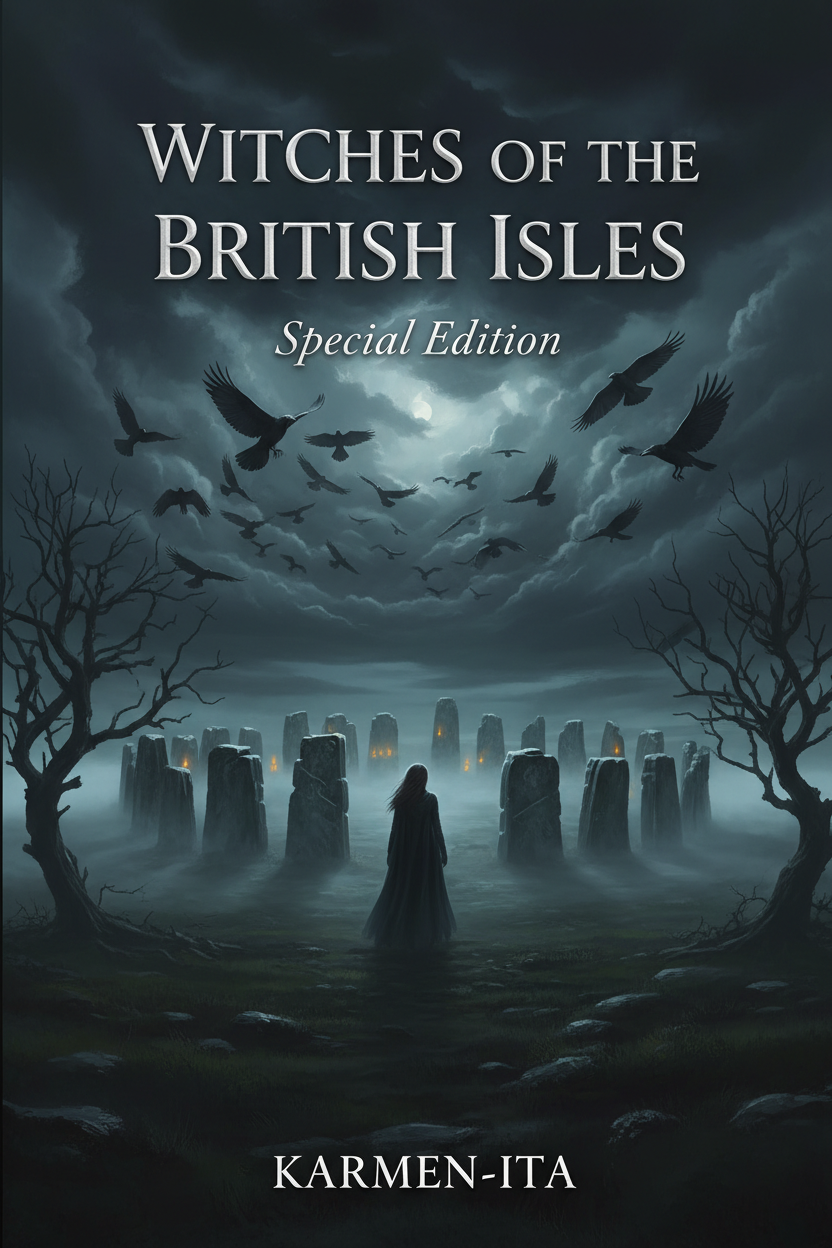
Witches of the British Isles — Special Edition
Witches of the British Isles — Special Edition
They were not what the trials said they were.
They were healers who knew which roots reduced a fever and which bark stopped bleeding. They were old women who lived alone and kept cats. They were midwives, herbalists, prophets, and troublemakers. They were queens whose political enemies needed a charge that would stick. They were poor, mostly. They were women, mostly. And in the sixteenth and seventeenth centuries, that was enough.
The British Isles produced some of the most documented witch trials in history — Agnes Waterhouse, the first to hang under England’s witchcraft laws; the Pendle Witches, twelve accused in a single Lancashire valley; the North Berwick trials, where James VI himself conducted interrogations. The records survive. The confessions survive, extracted under torture, shaped by the questions of the men who asked them. What does not always survive is the truth of who these women actually were.
This book holds sixteen stories — some historical, some folkloric, some existing in the uncertain space between the two. Agnes Waterhouse and the Pendle Witches left court records. Mother Shipton left prophecies that may or may not have been hers. Black Annis and Jenny Greenteeth left only the warnings parents gave their children near dark water. The Cailleach left the mountains.
What unites them is not magic. It is what the word witch was made to carry — the fear of women who knew things, who lived outside the expected boundaries, who could not easily be controlled. The category was never stable. It bent to fit whoever needed to be destroyed, or explained, or remembered.
But persecution is only half the story. The other half is power — real power, claimed and exercised. Cunning women and wise men were consulted, paid, respected. Their knowledge worked, or was believed to work, which in practice amounts to the same thing.
Sixteen stories. Centuries of silence. One book that gives them back their names.
PREFACE
They were not what the trials said they were.
They were healers who knew which roots reduced a fever and which bark stopped bleeding. They were old women who lived alone and kept cats. They were midwives, herbalists, prophets, and troublemakers. They were queens whose political enemies needed a charge that would stick. They were poor, mostly. They were women, mostly. And in the sixteenth and seventeenth centuries, that was enough.
The British Isles produced some of the most documented witch trials in history — Agnes Waterhouse, the first to hang under England’s witchcraft laws; the Pendle Witches, twelve accused in a single Lancashire valley; the North Berwick trials, where James VI himself conducted interrogations. The records survive. The confessions survive, extracted under torture, shaped by the questions of the men who asked them. What does not always survive is the truth of who these women actually were.
This book holds sixteen stories — some historical, some folkloric, some existing in the uncertain space between the two. Agnes Waterhouse and the Pendle Witches left court records. Mother Shipton left prophecies that may or may not have been hers. Black Annis and Jenny Greenteeth left only the warnings parents gave their children near dark water. The Cailleach left the mountains.
What unites them is not magic. It is what the word witch was made to carry — the fear of women who knew things, who lived outside the expected boundaries, who could not easily be controlled. The category was never stable. It bent to fit whoever needed to be destroyed, or explained, or remembered.
But persecution is only half the story. The other half is power — real power, claimed and exercised. Cunning women and wise men were consulted, paid, respected. Their knowledge worked, or was believed to work, which in practice amounts to the same thing. They occupied a space the church and the physicians could not fill, and communities protected them for it, quietly, despite official prohibition.
These stories are arranged roughly in chronological order, though chronology is approximate for figures who exist primarily in legend. Each chapter draws on historical records, folklore collections, and scholarly research — not to flatten the complexity of these women into a single narrative, but to let that complexity show.
Read them slowly. The patterns will emerge on their own — the vulnerability, the accusation, the confession, the silence. But also the resistance. The women who refused to confess even when confession might have saved them. The legends that kept powerful female figures alive across centuries, in the mouths of people who had every reason to forget them.
They were called witches. This book gives them back something closer to the truth.
KARMEN-ITA
📦 DELIVERY
Digital file via email within 12 hours
📱 SUPPORT
Telegram: https://t.me/KARMENINFO
✍️ AUTHOR
© KARMEN-ITA - Italian Digital Art
Format: High-quality digital PDF in English.
Impossibile caricare la disponibilità di ritiro